Total Abs workout

Monday, 26 January 2015

5 Pieces of Abdominal Exercise Equipment for your Ab Workouts

People are always looking for the best ab exercise equipment and here is a run-down of 5 pieces of equipment that you can use in your ab workouts (for pictures and full descriptions of more than 50 abdominal exercises check the resource box below).

#1 The Stability Ball (Exercise Ball)

The stability ball is a great piece of equipment. In addition to increasing range of motion for crunches and other abdominal exercises, the stability ball also improves your balance and coordination. You can start with the basics such as regular crunches or oblique crunches.

After mastering crunches you can move to something more challenging such as roll-ins or piques. In roll-ins and piques your feet are placed on the ball while your hands are on the floor.

The stability ball ab exercises are a good addition to your ab workout.

#2 The Medicine Ball

The medicine ball is simply a weighted ball. Although some people may think that medicine balls are only for boxers and athletes, medicine balls can really enhance your core workout.

When basic crunches or other ab exercises become too easy, adding resistance in the form of a medicine ball is a great way to increase the intensity of your ab workout. Some of the best medicine ball exercises are seated Russian twists and medicine ball toe touch crunches.

#3 Ankle Weights

Medicine balls are a great way to add resistance to your upper body, and ankle weights are a great way to add resistance to your lower body.

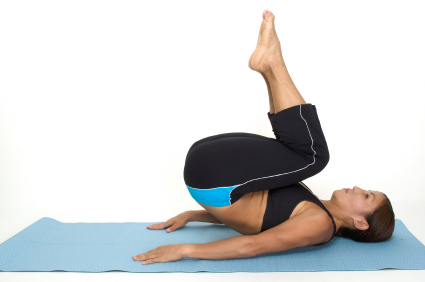
Ankle weights can increase the intensity of reverse crunches and leg raises. When regular leg raises become really easy, you can add ankle weights to increase the muscle work in your abs.

#4 Cables or Resistance Tubes

Here is another way you can add resistance to your abdominal muscles to break through strength.

You can perform cable crunches from a low cable tower by lying on the floor and holding the resistance behind your head. Or you can perform cable crunches from a kneeling position.

The cables add a very different feeling to your abdominal muscles because of the constant tension from the weight stack, so your abs get a burn throughout the entire range of motion.

#5 Ab Wheel

The ab wheel or power wheel is just what it says it is. It is a wheel with a stick in between it. You basically use the ab wheel for roll outs, and this is a very challenging abdominal exercise.

There are hundreds of ways to work your abdominal muscles, and above are just 5 good pieces to include in your ab workouts.

An if you don't have any ab exercise equipment available, the floor is always a good option. Some of my favorite ab exercises are bicycle crunches and the plank. So no excuses. Start working your abdominals.

Source: http://www.artipot.com/articles/163972/5-pieces-of-abdominal-exercise-equipment-for-your-ab-workouts.htm

Monday, 19 January 2015

The Psoas Muscles and Abdominal Exercises For Back Pain

Common opinion notwithstanding, the proper purpose of abdominal exercises is to awaken control of the abdominal muscles so they coordinate better with the other muscles of the trunk and legs (which include the psoas muscles). It is that better coordination that improves alignment, and not merely higher tone or strength. When the psoas muscles achieve their proper length, tone (tonus) and responsiveness, they stabilize the lumbar spine in movement as well as when standing, giving the feeling of better support and "strength". Mutual coordination of the psoas and other muscles causes/allows the spine and abdomen to fall back, giving the appearance of "strong" abdominal muscles -- but it is not the strength of abdominal muscles, alone, but the coordination of all the involved muscles that gives that appearance. To improve psoas functioning, a different approach to abdominal exercises than the one commonly practiced is necessary. Instead of "strengthening," the emphasis must be on awareness, control, balancing and coordination of the involved muscles - the purview of somatic education. I will say more... ... but first: A discussion of the methods and techniques of somatic education is beyond the scope of this paper, which confines itself to a discussion of the relation of the psoas muscles, abdominal exercises, and back pain. For that, see the links at the bottom of this article.

The Relationship of Psoas, Abdominal Muscles and Back Pain
The psoas muscles and the abdominal muscles function as agonist and antagonist (opponents) as well as synergists (mutual helpers); a free interplay between the two is appropriate. The psoas muscles lie behind the abdominal contents, running from the lumbar spine to the inner thighs near the hip joints (lesser trochanters); the abdominal muscles lie in front of the abdominal contents, running from the lower borders of the ribs (with the rectus muscles as high as the nipples) to the frontal lines of the pelvis.
Take a moment to contemplate each of these relationships until you can feel or visualize them
  • In the standing position, contracted psoas muscles (which ride over the pubic crests) move the pubis backward; the abdominal muscles move the pubis forward. (antagonists)
  • In walking, the ilio-psoas muscles of one side initiate movement of that leg forward, while the abdominals bring the same-side hip and pubis forward. (synergists)
  • The psoas major muscles pull the lumbar spine forward; the abdominal muscles push the lumbar spine back (via pressure on abdominal contents and change of pelvic position). (antagonists)
  • The psoas minor muscles pull the fronts of attached vertebrae (at the level of the diaphragm), down and back; the abdominals push the same area back. (synergists)
  • Unilateral contraction of the psoas muscles causes rotation of the torso away from the side of contraction and sidebending toward the side of contraction (as if leaning to one side and looking over ones raised shoulder); abdominals assist that movement.
Now, if this all sounds complicated, it is -- to the mind. But if you have good use and coordination of those muscles, it's simple -- you move well.

Words on Abdominal Exercises
Exercises that attempt to flatten the belly (e.g., crunches) generally produce a set pattern in which the abdominal muscles merely overpower psoas and spinal extensor muscles that are already set at too high a level of tension. High abdominal muscle tone from abdominal crunches interferes with the ability to stand fully erect, as the contracted abdominal muscles drag the front of the ribs down. Numerous consequences follow:
(1) breathing is impaired,
(2) compression of abdominal contents results, impeding circulation,
(3) deprived of the pumping effect of motion on fluid circulation, the lumbar plexus, which is embedded in the psoas, becomes less functional (slowed circulation slows tissue nutrition and removal of metabolic waste; nerve plexus metabolism slows; chronic constipation often results),
(4) displacement of the centers of gravity of the body's segments from a vertical arrangement (standing or sitting) deprives them of support; gravity then drags them down and further in the direction of displacement; muscular involvement (at the back of the body) then becomes necessary to counteract what is, in effect, a movement toward collapse. This muscular effort
(a) taxes the body's vital resources,
(b) introduces strain in the involved musculature (e.g., the extensors of the back), and
(c) sets the stage for back pain and back injury.
The psoas has often been portrayed as the villain in back pain, and exercise is often intended to overpower the psoas muscles by pushing the spine and abdomen back. However, it is obvious from the foregoing that "inconvenient" consequences result from that strategy. A more fitting approach is to balance the interaction of the psoas and abdominal muscles.
When the psoas and the abdominal muscles counterbalance each other, the psoas muscles contract and relax, shorten and lengthen appropriately in movement. The lumbar curve, rather than increasing, decreases; the back flattens and the abdominal contents move back into the abdominal cavity, where they are supported instead of hanging forward.

It should be noted that the pelvic orientation, and thus the spinal curves, is also largely determined by the musculature and connective tissue of the legs, which connect the legs with the pelvis and torso. If the legs are not directly beneath the pelvis, but are somewhat behind (or more rarely, ahead of the pelvis), stresses are introduced through muscles and connective tissue that displace the pelvis. Rotation of the pelvis, hip height asymmetry, and/or excessive lordosis (or, more rarely, kyphosis) follow, all of which affect the psoas/abdominal interplay. Where movement, visceral (organ) function, and freedom from back pain are concerned, proper support from the legs is as important as the free, reciprocal interplay of the psoas and abdominal muscles.

Article Source: http://EzineArticles.com/102447

Monday, 12 January 2015

Finding Out About Abdominal Exercises


There are four muscles that make up the anterior abdominal wall. The muscles making up the said abdominal wall are the rectus abdominis muscle, the internal and external obliques, and the transversus abdominis. Measurements of the effectiveness of abdominal exercises are made with the use of the Electromyography (EMG). The measurement is done in relation to the traditional crunch. The exercises are aimed primarily to the rectus abdominis muscle.

Abdominal exercises are not really helpful in the reduction of belly fat. The exercises are intended for the abdominal muscles or commonly know as the stomach muscles. The exercises for the abdominal muscles are helpful in the building up of the said muscles of the body. The improvement of the muscles is useful in some sports competitions.

Exercises for abdominal muscles have some safety concerns. The lower back is stressed unnecessarily when a compressive force is applied to the lumbar spine. Respiratory problems might be caused by exaggerated exercises for the abdomen. No single exercise among twelve for abdominal muscles is applicable for all the abdominal muscles.
There are non-traditional exercises for abdominal muscles. These exercises are for individuals who do not want to undergo exercises the usual way. Some persons get bored in traditional exercises for abdominal muscles. A unique exercise for abdominal muscles can be done instead. The usual crunches and sit-ups are not included in the unique exercises for abdominal muscles.
The exercises aim at boosting the metabolism of the body. The high intensity exercises are geared toward the entire body including the abdominal area. The result is a hard abdomen, hard as a rock, and resulting to better fat burning exercises.
The World Wide Web is an efficient tool to understand the various exercises for the abdominal region of the body. Lots of information is easily accessible in the internet for individuals who are interested in the exercises for the abdomen. There are traditional exercises as well as exercises which are considered as unusual. Websites offering health tips are easily available for surfing to health-conscious especially those who are looking for tips and suggestions for keeping physically fit bodies.
Abdominal exercises are among the fitness procedures online. Persons who like to read and understand these kinds of exercises can quickly get their health plans and workout requirements in the internet. Services are offered for free or for sale in the different internet sites. Those exercises for abdomen that are for sale have their features to attract potential buyers. Free and on sale exercises are available for any one who wishes to enjoy the benefits of these exercises from any place in the world

Article Source: http://EzineArticles.com/6144100

Monday, 5 January 2015

How To Burn Stomach Fat & Reduce it Fast

In gyms and fitness centers everywhere there are people working on machines and performing abdominal exercises to tighten and firm the muscles for a sleek, six-pack muscle look and feel. Many people begin a workout regimen because they feel the middle portion of their bodies have gotten flabby and unattractive. There are hundreds of abdominal rollers, twisters, rockers and manipulators all promising lean, sexy abdominals. Most of them are sitting in the corner after a few weeks of useless results.


Firmer Abs with Electro Stimulation

The latest sensation promising results without having to resort to uncomfortable abdominal exercises such as crunches is the electro stimulation belts. These belts are based on the principle of the stimulators used by many medical rehabilitation facilities that use electric stimulation to keep muscles from atrophying when patients are immobile. The electrodes in the muscle stimulators contract muscles and keep the muscles active even when a person is not able to move.

A person wears these specially constructed abdominal belts that come with gel pads strategically positioned inside the belt to target the central abdominal and oblique muscles. The belt sends electric stimulation signals to the nerves which then branch out to all the stomach muscles causing contractions so all the muscles are stimulated naturally and safely.


Source: http://www.youtube.com/watch?v=Cypm7NibSEk

Monday, 29 December 2014

The Abdominal Exercise Device for the Luggage

More and more people know, resistance training is beneficial and they don't want to go without it anymore. But often there is a time problem for busy people to work out regularly, especially if they have to travel. One good solution to this problem is to perform ab exercises with a situp bar.

A door adjustable sit up bar is small and portable, that's why it often is called the tool of abdominal exercise equipment for the luggage. This type of sit up bars can be fastened to the lower edge of almost every door, at home, in the office, or in a hotel room. Pads on both sides prevent scratching the door. Tightly screwed, the situp bar supports the stomach workout very well. The abdominal workout is easier and more effective than exercises without a piece of abs equipment.

With the situp bar, people can strengthen and tone not only their abs. The whole mid-section gets toned and the thighs get trimmed. Sit up bars support of course sit ups, but also crunches and leg raises. Regular abs training is crucial for people who are working on a six pack. But also people with lower expectations will get great benefits by doing regular abdominal exercises. That doesn't mean heavy love handles or a pouch abdomen would disappear immediately. Nobody can reduce the fat on the spot, but - for example - with three minutes abs exercises daily one will feel a difference after a few weeks. There will be a stronger feeling in the mid-section and the trousers will fit better.

Other benefits are better posture, better breathing, and better digestion. Over a long term, muscle mass increases and that leads to the greatest benefit of resistance training: Higher basal metabolism - the body consumes more calories during the state of rest. This is the best base for healthy weight loss, weight control, and long term strength. Even older people can increase their muscle mass and get the benefits. Another great side effect of more muscle mass is getting stronger bones. That's because the bones get nourished via the muscle tissue which increases with the increasing muscle mass.

One might ask, abdominal exercises are just one option of resistance training, why to choose them? Of course, there are many options to build up muscle mass. It is a great thing to go to the gym regularly and to train all muscles. But even if there is a gym close by, to go there needs a lot of time, not to talk about the money. Many people who want to go to the gym can't do it and they do nothing. On the other hand: Muscle training is so important for a healthy life that everybody should do it. And besides the gym, there are more options. There is a wide variety of exercise equipment for home exercisers, even a wide variety of abs equipment. Abdominal training would be a good start for beginners. It needs just minutes and gives a better and stronger feeling soon. Everybody could train at home and get the benefits. A situp bar is just one option. It is one of the best to have at home or to carry around in the luggage.

Last but not least a sit up bar is not only small it is cheap as well. There are good sit up bars on the market for about 10 to 20 Dollars. Some come with a wall chart or a video worth to get to know. That makes the exercisers able to do the abs exercises with this little piece of abdominal exercise equipment correctly and effectively from the first moment. Older people or beginners with health problems, who are motivated to do abs workout, should have small talk with their doctor before they start.

Source: http://www.artipot.com/articles/1072602/door-adjustable-situp-bar-the-abdominal-exercise-device-for-the-luggage.htm